Tr
Upper Third
The upper third typically runs from the hairline area to the brow region. This part of a facial thirds calculator is helpful, but hair coverage or a high hairline can reduce confidence.
Upload a clear front-facing photo to measure facial thirds online. Our facial thirds calculator estimates the upper, middle, and lower face proportions, compares them to the classic 1:1:1 reference, and explains how balanced your facial thirds look in one quick result.


Use a straight-on photo with your hairline, nose base, and chin clearly visible
Best for selfies or portraits with even lighting and a neutral expression.
Facial thirds divide the face into three vertical sections so you can assess facial balance, not just a single beauty score.
A facial thirds calculator focuses on vertical face proportions. In a classic facial thirds test, the face is divided into an upper third, a middle third, and a lower third. These sections are often compared with the traditional 1:1:1 facial thirds ratio used in orthodontics, dentistry, and facial aesthetics.
That does not mean every attractive face must have perfectly equal thirds. A facial thirds calculator is most useful as a reference tool. It helps you see whether one area looks longer or shorter than the others and whether your lower facial third follows the common 1:2 split between the upper lip area and the lower lip plus chin.
To measure facial thirds from a photo, start with a level front-facing portrait. Mark the hairline area, brow region, base of the nose, and chin, then compare the three vertical distances. This calculator automates that workflow so the result is easier to review than drawing lines manually on a selfie.
The upper third typically runs from the hairline area to the brow region. This part of a facial thirds calculator is helpful, but hair coverage or a high hairline can reduce confidence.
The middle third usually runs from the brow region to the base of the nose. A longer or shorter middle third can strongly affect how balanced the face appears in a facial thirds test.
The lower third runs from the base of the nose to the chin. Many users of a facial thirds calculator want to know if this area looks short, balanced, or slightly long compared with the upper and middle thirds.
The lower facial third is often reviewed again using a 1:2 reference. In practical terms, the upper lip area usually takes about one third, while the lower lip and chin take about two thirds.
Choose a clear image where your full face is visible. A facial thirds calculator works best when the camera is level, the face is centered, and your hairline and chin are not hidden.
Our facial thirds test estimates the upper, middle, and lower face proportions from your photo. It also checks the lower facial third split and gives a confidence label based on photo quality and visible landmarks.
See whether your face looks balanced overall, whether one third appears slightly longer or shorter, and how your photo compares with the classic facial thirds ratio and lower-third 1:2 reference.
A balanced facial thirds ratio is a reference point, not a rule every face must match exactly.
The result estimates upper, middle, and lower face height from visible landmarks and compares them with the common 1:1:1 facial thirds reference.
The lower facial third can also be checked as the distance from nose base to mouth and from mouth to chin. This helps explain why the lower face may appear short or long.
Hair covering the hairline, chin cropping, a tilted head, or a smile can reduce confidence. Retake the photo before comparing results across different images.
The result estimates upper, middle, and lower face height from visible landmarks and compares them with the common 1:1:1 facial thirds reference.
A facial thirds calculator usually compares your photo with the classic 1:1:1 facial thirds ratio, where the upper, middle, and lower face sections are close in height. This reference is common in orthodontic and aesthetic analysis because it offers a quick way to describe vertical facial balance. The point of a facial thirds test is not to claim that one rigid proportion defines beauty. Instead, it gives you a practical guide for understanding whether one part of the face appears longer, shorter, or close to balanced in relation to the others.
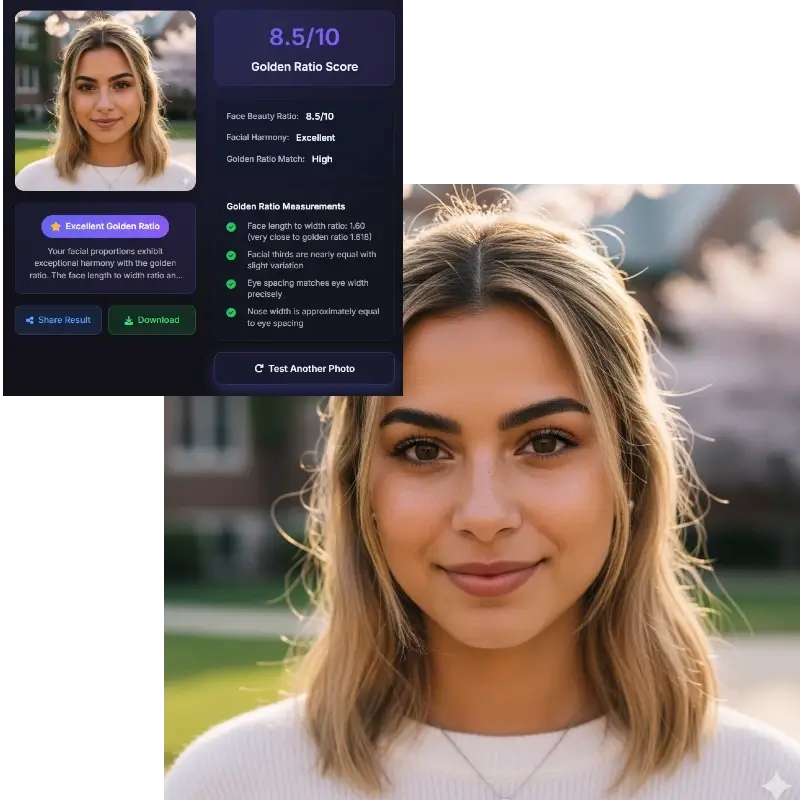
If you want a more reliable facial thirds calculator result, photo setup matters almost as much as the algorithm. A front-facing image with even lighting helps the system identify the hairline area, brow region, nose base, and chin more consistently. A tilted head, hidden forehead, smile, shadow, or beauty filter can distort the facial thirds ratio. That is why a good facial thirds test should always explain confidence, not just output a number or label without context.
Check golden ratio face with photo upload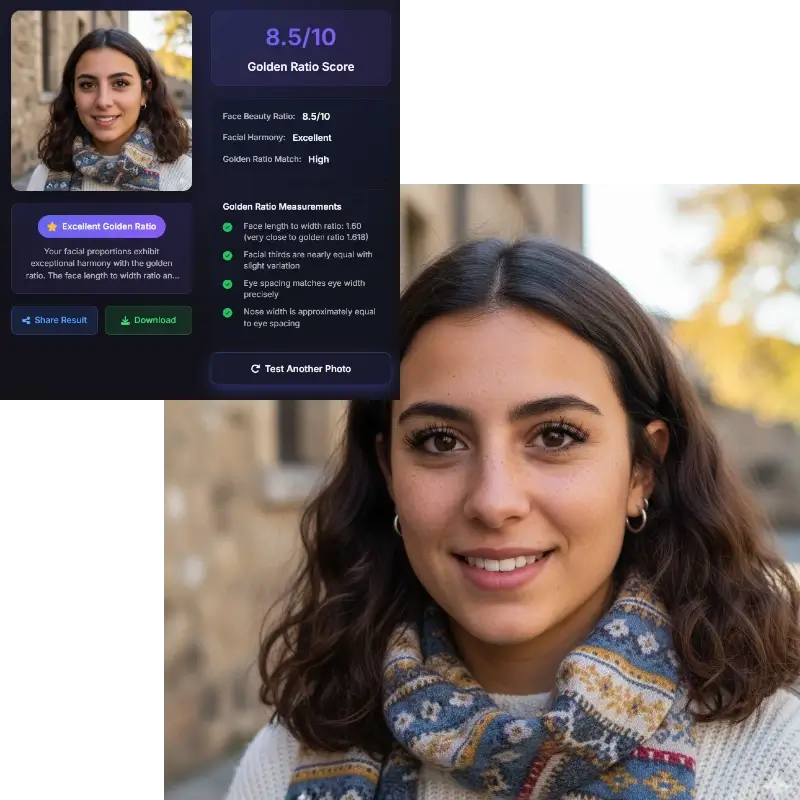
The best use of a facial thirds calculator is interpretation. Instead of only asking whether your facial thirds are perfect, it is more helpful to know whether the upper third, middle third, or lower third stands out and whether the lower facial third looks proportionate. This page is built around that user intent. Your facial thirds test result highlights the pattern first, then shows the estimated upper, middle, and lower thirds, the lower-third split, and a short explanation you can actually use.

Research and clinical practice both show that facial proportions are useful, but natural variation is normal. Men and women often show different average distributions, age can change the lower face, and hairline visibility can change how a facial thirds calculator reads the upper third. That is why a facial thirds test should be treated as an educational estimate. It can help you understand facial balance, prepare for a cosmetic consultation, or compare photos, but it should not be treated as a medical diagnosis or a final verdict on attractiveness.

A facial thirds calculator is only as good as the landmarks it can see.
A facial thirds calculator works best with a straight-on photo. Side angles and head tilt can make the upper, middle, and lower thirds look longer or shorter than they really are.
Harsh shadows can hide the brow region, nose base, and chin. Soft, even light gives your facial thirds test a better chance of identifying landmarks accurately.
A relaxed, closed-mouth expression makes the lower facial third easier to estimate. Smiling or pressing the lips together can change the lower-third split.
The upper third is harder to estimate when bangs, hats, or cropping hide the forehead. If your hairline is covered, the facial thirds calculator may return lower confidence.
For the strongest result, take the photo at eye level, keep the camera parallel to your face, avoid wide-angle distortion, and leave a little space above the hairline and below the chin. If you want a manual walkthrough before using the calculator, read the step-by-step guide on how to measure facial thirds from a photo. If you want to compare golden ratio face balance as well, use the main upload photo calculator after reviewing your thirds.
These example images reflect the type of balanced facial proportions people often compare in a facial thirds calculator.
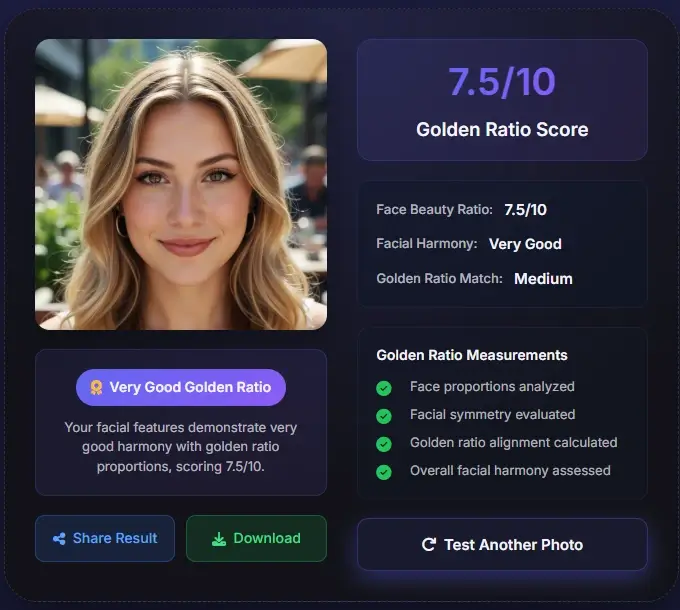
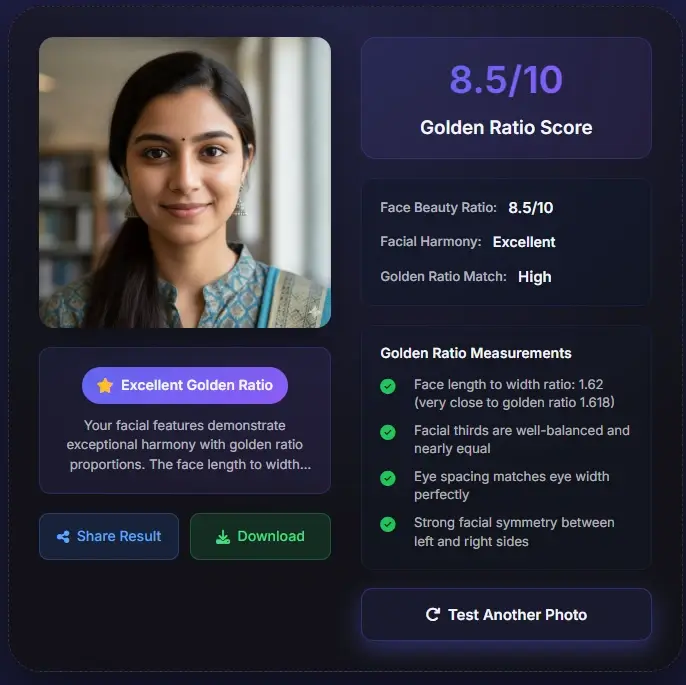

Facial thirds are a simple way to divide the face into three vertical sections: upper, middle, and lower. A facial thirds calculator compares those sections to a common reference so you can understand overall facial balance.
A facial thirds test usually estimates the distance from the hairline area to the brow region, from the brow region to the base of the nose, and from the base of the nose to the chin. A photo-based facial thirds calculator does this by detecting landmarks in a front-facing image.
Use a level, front-facing photo where the hairline area, brow region, nose base, and chin are visible. This facial thirds calculator detects those landmarks, estimates the three vertical sections, and compares them with the common 1:1:1 reference so you do not need to draw measurement lines manually.
Not necessarily. The classic facial thirds ratio is close to 1:1:1, but real faces vary by sex, age, ancestry, hairline shape, and soft tissue changes. A facial thirds calculator should treat that ratio as a reference, not a universal rule.
Within the lower facial third, a common reference is about 1:2. That means the upper lip area takes roughly one third and the lower lip plus chin take roughly two thirds. A facial thirds calculator can use that lower-third split to add more context to the main facial thirds test.
The upper third depends on estimating the top facial landmark near the hairline. If your forehead is cropped, covered by bangs, or hidden by a hat, the facial thirds calculator has less information and may return lower confidence.
No. A facial thirds calculator is an educational, photo-based estimate of vertical facial proportions. It can help you discuss balance and symmetry, but it is not a medical diagnosis and should not replace an in-person evaluation.
They are closely related, but not identical. Equal facial thirds describes the classic 1:1:1 reference. Facial thirds ratio is the measured comparison between your upper, middle, and lower sections, which may be close to equal or show one section as longer or shorter.
For quick online review, yes. The calculator is faster than drawing lines manually and helps explain the result. Manual measurement may still be useful when hairline visibility is poor or when you want a professional orthodontic or aesthetic assessment.