What is the Golden Ratio Face? The Science Behind Facial Beauty
From Ancient Greece to AI: A Deep Dive into the Math, Myth, and Meaning of Facial Proportions

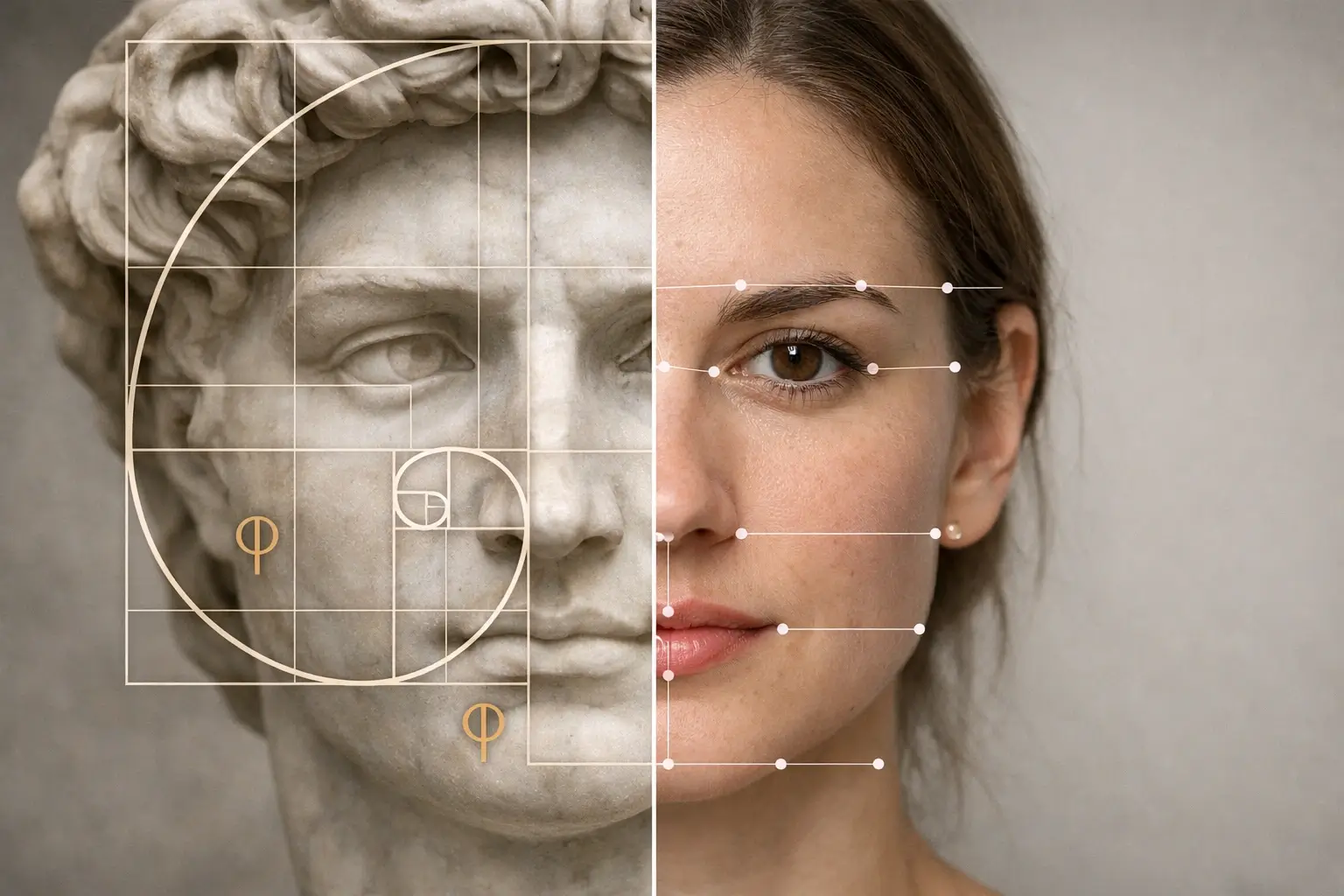
Table of Contents
There is a number that has haunted artists, architects, and surgeons for centuries. It is called phi and it equals approximately 1.618. Some call it the divine proportion. Others call it the golden ratio. And for the past few decades, a growing number of people have been using it to measure something far more personal: the beauty of a human face.
If you have ever uploaded a photo to a face analysis tool and received a score, you have encountered the golden ratio face concept firsthand. But what does it actually mean? Is it real science, or a beautiful myth? And does your score actually tell you anything meaningful?
I have spent a long time digging into the research: the studies that support the golden ratio, the ones that challenge it, and the fascinating history in between. Here is everything you need to know.
What is the Golden Ratio (phi = 1.618)?
The golden ratio is a mathematical relationship between two quantities. If you divide a line into two segments, a longer part (a) and a shorter part (b), the golden ratio occurs when the ratio of the whole line to the longer segment equals the ratio of the longer segment to the shorter one. In other words: (a + b) / a = a / b = 1.618.
What makes this number remarkable is how often it appears in nature. The spiral of a nautilus shell, the arrangement of seeds in a sunflower, the branching of trees, the proportions of a DNA helix: all approximate the golden ratio. Ancient Greek mathematicians first described it around 300 BCE, and it has fascinated thinkers ever since.
In art and architecture, the golden ratio has been used, or claimed to have been used, in the Parthenon, the Great Pyramid of Giza, and countless Renaissance paintings. Whether these applications were intentional or retrospective is a matter of ongoing debate among historians. But the aesthetic appeal of the proportion is hard to deny.
The Math in Plain English
Imagine a rectangle where the ratio of its long side to its short side is 1.618. If you cut a square from it, the remaining rectangle has the exact same proportions. You can keep doing this infinitely. That self-similar quality is part of what makes the golden ratio feel so harmonious: it is a proportion that contains itself.
What is a Golden Ratio Face?
A golden ratio face is one where the key proportions of the face, including length to width, the spacing of features, and the vertical thirds, closely approximate 1.618. The idea is that faces whose measurements align with this ratio are perceived as more balanced, harmonious, and attractive.
When applied to facial aesthetics, the golden ratio is used to evaluate several dimensions simultaneously. It is not just about one measurement: it is about the overall harmony of how your features relate to each other. A face can have a perfectly proportioned nose but an imbalanced overall structure, and vice versa.
The concept gained mainstream traction in the early 2000s, largely thanks to the work of Dr. Stephen Marquardt, a California-based oral and maxillofacial surgeon who developed the Phi Mask, a geometric overlay based on the golden ratio that he claimed represented the ideal human face. Today, AI tools like ours use similar principles, combined with machine learning, to analyze facial proportions from a photo in seconds.
Quick Definition
A golden ratio face is one where facial proportions, including length-to-width ratio, feature spacing, and vertical thirds, closely match the mathematical constant phi (1.618). It is a framework for measuring facial harmony, not a verdict on beauty.
The 12 Key Facial Measurements
Modern golden ratio face calculators, including AI-powered tools, typically analyze up to 12 distinct measurements. Here is what each one captures and why it matters:
| Measurement | What It Captures | Golden Ratio Ideal |
|---|---|---|
| Face length / face width | Overall face shape and proportions | 1.618 |
| Hairline to brow / brow to nose base | Upper third balance | Equal (1:1) |
| Brow to nose base / nose base to chin | Lower face balance | Equal (1:1) |
| Eye width / inter-eye distance | Eye spacing harmony | Equal (1:1) |
| Nose width / mouth width | Nose-to-mouth proportion | 1:1.618 |
| Mouth width / face width | Mouth proportion | ~0.5 of face width |
| Nose tip to chin / lips to chin | Lower face ratio | 1.618 |
| Pupil to nose tip / pupil to lip | Mid-face proportion | 1.618 |
| Head width / head height | Overall head shape | 1:1.618 |
| Hairline to pupil / nose tip to chin | Vertical face balance | 1.618 |
| Outer eye distance / face width | Eye placement | ~0.46 of face width |
| Nose width / eye width | Feature scale harmony | 1:1 |
No single measurement determines your score. The overall golden ratio face result is a composite: a weighted average of how closely all these proportions align with phi. That is why two people with the same nose width can have very different scores.
From Da Vinci to Dr. Marquardt: A Brief History
The application of the golden ratio to the human face has a surprisingly long history, though it is also a history full of myths and misattributions.
Leonardo da Vinci is often cited as the first to apply the golden ratio to facial proportions, particularly in his famous Vitruvian Man (c. 1490). Da Vinci was deeply interested in the mathematical proportions of the human body, and his notebooks contain extensive measurements. Whether he explicitly used phi in his facial studies is debated by art historians, but the connection between Renaissance art and the golden ratio is well-established.
The more direct application to facial beauty came much later. In 2001, Dr. Stephen R. Marquardt, a surgeon who had spent years studying what made faces appear attractive across cultures and time periods, published his Phi Mask. This geometric overlay, constructed entirely from golden ratio proportions, was designed to represent the ideal human face. Marquardt claimed the mask fit attractive faces across all ethnicities and historical periods, from ancient Egyptian art to modern Hollywood.
The Phi Mask became enormously influential in cosmetic surgery and orthodontics. Surgeons began using it as a reference point for procedures. Beauty pageants referenced it. And eventually, it became the conceptual foundation for the wave of online golden ratio face calculators that emerged in the 2010s.
A Note on Marquardt's Mask
Marquardt's Phi Mask was never published in a peer-reviewed journal: it was patented. Subsequent academic research has raised significant questions about its universality and scientific validity. We cover that in the science section below.
How to Measure Your Golden Ratio Face
There are two ways to measure your golden ratio face: manually with a ruler and calculator, or using an AI-powered tool that does it automatically from a photo.
Manual Measurement (The Old-School Way)
- Measure your face length from hairline to chin
- Measure your face width at the widest point (usually cheekbone to cheekbone)
- Divide face length by face width: the closer to 1.618, the better
- Measure the three vertical thirds: hairline to brow, brow to nose base, nose base to chin
- Check if all three thirds are roughly equal
- Measure eye width and the distance between your eyes: ideally equal
- Measure nose width and compare to mouth width: ideal ratio is 1:1.618
Manual measurement is imprecise and time-consuming. Small errors in measurement placement can significantly affect your results. It is a useful exercise for understanding the concept, but not the most reliable way to get an accurate score.
AI-Powered Measurement (The Modern Way)
AI golden ratio face calculators like ours use computer vision to detect facial landmarks, typically 68 to 194 precise points on your face, and calculate all 12 measurements simultaneously. The process takes seconds and is far more consistent than manual measurement.
- Upload a clear, front-facing photo with good lighting
- The AI detects your facial landmarks automatically
- All 12 key measurements are calculated and compared to phi
- You receive an overall golden ratio score plus a breakdown by feature
- Results are instant, no account required
Related tools context
If your goal is not just theory, compare the article with the free upload tool and the facial thirds calculator. The tool checks photo-based face ratio cues, while the thirds calculator isolates upper, middle, and lower face balance.
Photo Tips for the Most Accurate Results
| Factor | Why It Matters | Best Practice |
|---|---|---|
| Lighting | Shadows distort landmark detection | Natural daylight, facing the light source |
| Angle | Off-axis photos skew all measurements | Straight-on, camera at eye level |
| Expression | Smiling changes lip and cheek measurements | Neutral, relaxed expression |
| Hair | Obscures hairline and face outline | Pull hair back from face |
| Glasses | Blocks eye landmark detection | Remove glasses |
| Resolution | Low quality reduces landmark accuracy | Use a modern smartphone camera |
Famous Faces and the Golden Ratio
One of the reasons the golden ratio face concept captured public imagination is the parade of celebrity analyses that have circulated online. Cosmetic surgeons and researchers have applied the Phi Mask to famous faces and published their findings, with results that make for compelling reading.
These analyses are fascinating, but they come with important caveats. Different researchers using slightly different methodologies produce different rankings. The measurements are often taken from photographs, which introduces variables like angle, lighting, and expression. And the choice of which celebrities to analyze is rarely random.
Notable Golden Ratio Face Scores (Various Studies)
Scores vary by study methodology and photo used. These figures are from published analyses and should be treated as illustrative, not definitive.
| Person | Reported Score | Source / Context |
|---|---|---|
| Amber Heard | 91.85% | Dr. Julian De Silva, 2016 analysis |
| Beyonce | 92.44% | Multiple published analyses |
| Kate Moss | 94.14% | Supermodel study, 2025 |
| Grace Kelly | ~95% | Marquardt Phi Mask overlay, classic case |
| Anya Taylor-Joy | High scorer | The Sun study, 2024 |
| Natalie Portman | High scorer | sciencesensei.com study, 2025 |
What these analyses do illustrate is that the golden ratio face framework can be applied consistently, and that faces widely considered beautiful do tend to score well. Whether that is because the golden ratio causes attractiveness, or simply correlates with it, is a different question entirely.
A Personal Note
I find these celebrity rankings genuinely interesting, but I also think they can be misleading. Plenty of people find faces that score lower far more compelling. Attractiveness is not a leaderboard. The golden ratio is a lens, not a verdict.
Does the Science Actually Support It?
This is the question I find most interesting, and the one that gets the most oversimplified in popular coverage. The honest answer is: it is complicated.
The Case For the Golden Ratio
There is genuine research supporting the idea that facial proportions matter for perceived attractiveness. Studies in evolutionary psychology consistently find that facial symmetry is associated with attractiveness across cultures, and the golden ratio is, at its core, a framework for measuring proportional harmony.
Research published in journals including Evolution and Human Behavior has found that faces rated as attractive tend to have proportions closer to population averages, and the golden ratio approximates those averages in many cases. The concept of averageness in facial attractiveness has strong empirical support. Learn more about the science of physical attractiveness on Wikipedia.
The Case Against the Golden Ratio
However, the specific claim that phi = 1.618 is the magic number for facial beauty is much harder to support. A 2024 systematic review published in Maxillofacial Plastic and Reconstructive Surgery concluded that there is no convincing evidence that the golden ratio is linked to idealized human proportions or facial beauty. Read the full 2024 peer-reviewed study in Maxillofacial Plastic and Reconstructive Surgery.
Separately, research from the University of California found that the most attractive faces had an eye-to-mouth distance of about 36% of face length, and an eye-to-eye distance of about 46% of face width, proportions that do not map neatly onto 1.618.
There is also the question of cultural bias. Most research on facial attractiveness has been conducted with Western participants and Western beauty standards. What is considered attractive varies significantly across cultures and time periods, a fact that any single mathematical formula struggles to accommodate.
The Balanced View
The golden ratio face is a useful framework for thinking about facial harmony and proportion. It is not a scientific law. Faces that score well on golden ratio metrics do tend to be widely perceived as attractive, but the relationship is correlational, not causal. And a low score absolutely does not mean a face is unattractive. Beauty, as ever, is more than a number.
Curious where your face lands on the golden ratio scale?
Try the Free Golden Ratio Face CalculatorFree, instant, no account required.
Frequently Asked Questions
About the Author
Emma Hartley
Science and beauty writer with a background in evolutionary psychology. Contributor to Refinery29 and Byrdie.
Emma Hartley has spent over a decade writing at the intersection of science, beauty, and culture. With a postgraduate background in evolutionary psychology from University College London, she brings rigorous research to topics that often get oversimplified. Her work has appeared in Refinery29, Byrdie, and The Pool. She believes beauty science should be honest, nuanced, and accessible to everyone.
References and Further Reading
- Peer, E., et al. (2024). The golden ratio: dispelling the myth. Maxillofacial Plastic and Reconstructive Surgery. Springer.
- Marquardt, S.R. (2002). Dr. Stephen R. Marquardt on the Golden Decagon and Human Facial Beauty. Journal of Clinical Orthodontics.
- Perrett, D.I., et al. (1999). Symmetry and human facial attractiveness. Evolution and Human Behavior, 20(5), 295-307.
- Pallett, P.M., Link, S., and Lee, K. (2010). New golden ratios for facial beauty. Vision Research, 50(2), 149-154.
- Rhodes, G. (2006). The evolutionary psychology of facial beauty. Annual Review of Psychology, 57, 199-226.
- National Institutes of Health / PMC. The golden ratio: dispelling the myth. PMC10792139.
- Wikipedia. Golden ratio. Wikimedia Foundation.
Last updated: July 4, 2026